Context Engineering Certification: Ready Next-Gen AI Skills


 Locked


 
|
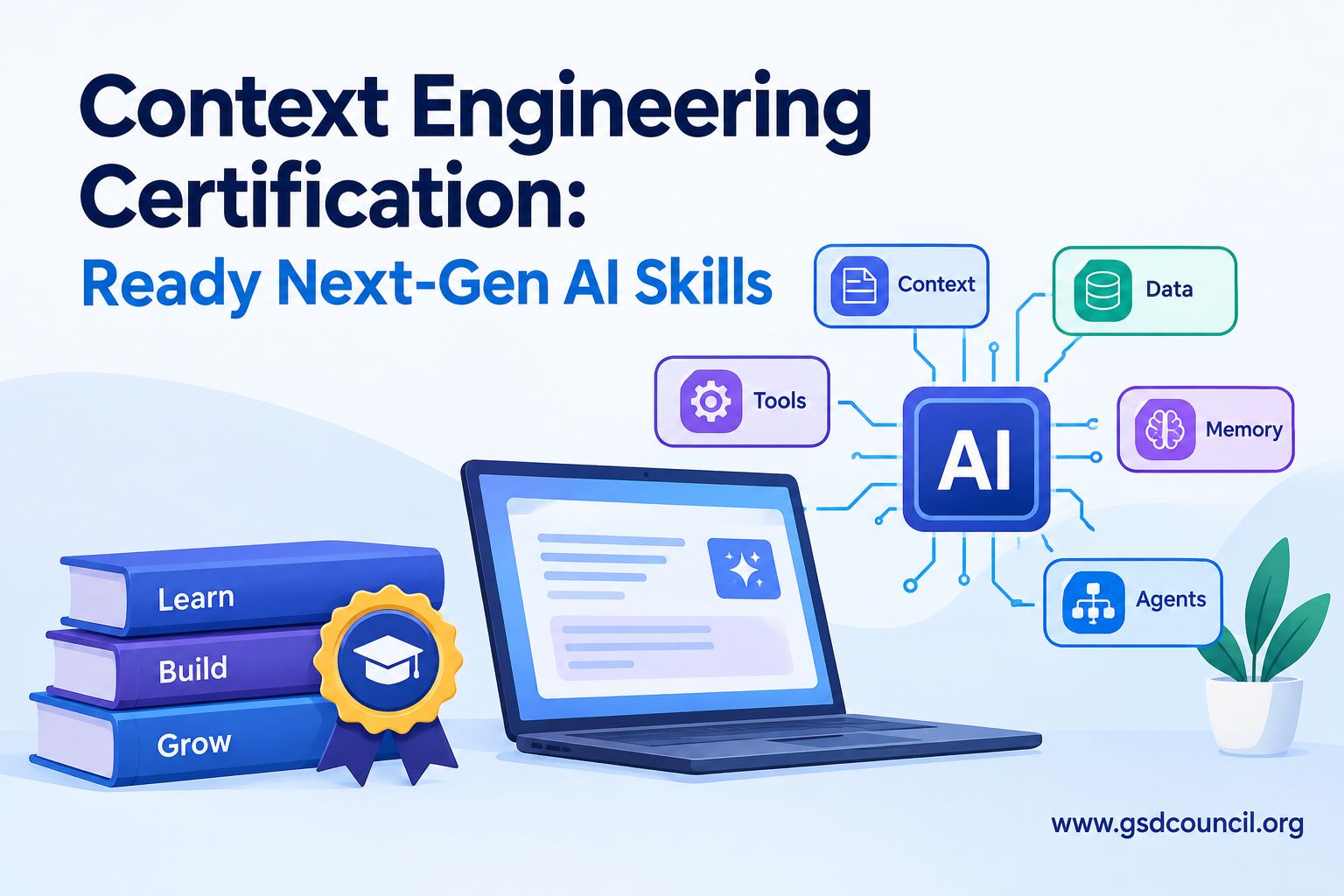 Introduction As generative AI evolves from simple chatbots to intelligent agents and enterprise applications, the ability to provide AI models with the right information at the right time is becoming increasingly important. Context engineering certification focuses on designing, structuring, and optimizing the information an LLM receives, including instructions, retrieved knowledge, memory, tools, metadata, and conversation history. IBM and Google Cloud both describe context engineering as a broader discipline than prompt engineering, particularly for RAG and agentic AI systems. What Skills Does a Context Engineer Need? A certified context engineer develops practical knowledge of context architecture, context-window management, prompt-to-context design, RAG pipelines, embeddings, vector databases, memory systems, tool calling, structured outputs, and AI-agent workflows. GSDC’s program specifically covers retrieval, memory, MCP, evaluation, security, and production context architecture. Professionals can develop these capabilities through a structured context engineering course or practical context engineering training, helping them understand how to create relevant, reliable, and efficient AI context. Benefits of Context Engineering Certification A context engineering certification online can help professionals formalize their knowledge while building skills applicable to modern LLM applications. The GSDC certification includes self-paced learning, live expert sessions, practical learning, a capstone project, and career-support resources. Job Opportunities After Certification Context engineering skills can support career paths such as AI Engineer, Generative AI Developer, LLM Application Developer, RAG Engineer, AI Solutions Architect, Prompt Engineer, and AI Agent Developer. As organizations deploy increasingly sophisticated AI applications, professionals who understand information retrieval, context management, tools, and evaluation can contribute to production AI systems. Market Demand & Industry Growth The industry is moving beyond isolated prompt design toward automated context pipelines that retrieve, filter, structure, and manage information before model inference. Google Cloud identifies this shift as a move toward structured AI environments, while IBM highlights context engineering’s importance for multi-step and agentic systems. Why Choose Context Engineering? Context engineering connects prompt engineering, RAG, memory, tools, and AI-agent architecture into a unified discipline. For professionals seeking future-focused AI skills, a context engineering course provides a practical pathway toward understanding how production-grade LLM applications are designed. Future Trends Context-aware AI agents, advanced RAG, long-context optimization, model-context protocols, automated retrieval, context compression, observability, and AI security are expected to remain important areas of development. Conclusion & Call-to-Action Context engineering is becoming an important foundation for reliable and scalable generative AI. Explore context engineering training to strengthen your technical capabilities and prepare for the evolving AI engineering landscape. https://www.gsdcouncil.org/context-engineering-certification #ContextEngineering #ContextEngineeringCertification #CertifiedContextEngineer #ContextEngineeringCourse #ContextEngineeringTraining |
«
Return to Forum
|
1 view|%1 views
| Free forum by Nabble | Edit this page |